
Selecting the correct specialty gas regulator is critical for achieving accurate results, protecting equipment and ensuring safe operation. While there are many regulator options available, choosing the right one becomes straightforward when you work through a few simple questions.
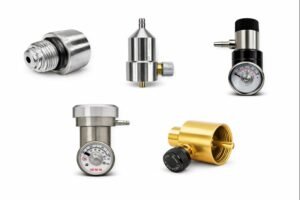
Step 1: Do You Require Pressure or Flow?
The first question to ask is what your instrument actually requires on the outlet side of the regulator — pressure or flow?
Although all specialty gas cylinder regulators are designed to handle high cylinder pressures, typically well above 150 bar, the important factor is what your analyser, instrument or process equipment needs at the point of use.
Gas detection instruments used for bump testing or calibration often require a controlled flow rate, commonly around 0.5 litres per minute.
Gas analysers, laboratory instruments and process equipment typically require a stable outlet pressure, often between 1 and 2 bar.
Your instrument manufacturer will normally specify whether the equipment requires pressure or flow, and this should always be your starting point when selecting a regulator.
Once this requirement has been identified, the regulator selection process becomes much easier.
Step 2: Determine the Required Outlet Flow Rate or Pressure
Once you know whether you require flow or pressure, the next step is determining the actual value required by your equipment.
Flow Regulators
Some flow regulators provide a fixed flow rate, while others offer adjustable or selectable flow settings to suit multiple applications.
Continuous flow regulators deliver gas at a constant flow rate regardless of the downstream demand and are commonly used for diffusion gas detectors and standard calibration applications.
If the instrument contains an internal sampling pump, an On-Demand Flow Regulator is generally the preferred option. These regulators only supply gas when the instrument creates a vacuum, allowing the instrument to draw exactly the amount of gas it requires.
This improves calibration accuracy and reduces unnecessary gas consumption.
Pressure Regulators
Pressure regulators are available in a range of outlet pressure settings such as:
- 0 to 1.5 bar
- 0 to 3.5 bar
- 0 to 10 bar
Select a regulator with an outlet range that comfortably includes your required operating pressure.
For example, if your analyser requires 2 bar inlet pressure, a regulator with a 0 to 3.5 bar outlet range would typically be the appropriate choice.
Step 3: Gas Type and Gas Concentration
The gas being used will largely determine the material of construction required for the regulator and associated system components.
Choosing incompatible materials can result in corrosion, contamination, shortened regulator life and inaccurate analytical results.
Highly corrosive gases such as chlorine, ammonia, hydrogen chloride, hydrogen cyanide and nitrogen dioxide generally require stainless steel regulators and wetted components.
Hydrogen sulphide and sulphur dioxide applications may be suitable for nickel plated brass at low concentrations, however higher concentrations often require stainless steel construction.
Non-corrosive gases and mixtures such as nitrogen, carbon dioxide, oxygen and many hydrocarbon mixtures are typically suitable for brass or nickel plated brass regulators.
It is also important to consider compatibility with tubing, fittings and seals throughout the entire gas delivery system.
For high purity gases or highly reactive gas mixtures, purge systems may also be recommended to maintain purity and maximise equipment life.
Step 4: Select the Correct Inlet Connection
The regulator inlet connection must match the cylinder valve fitted to the gas cylinder.
Cylinder valve standards vary depending on the gas type, country of manufacture and local regulations.
You may encounter Australian, British, North American or European valve standards depending on the supplier and origin of the gas cylinder.
Even the same gas mixture may be supplied with different valve connections depending on where it was filled.
Before ordering a regulator, always confirm the exact valve type fitted to the cylinder.
Fortunately, inlet connectors can often be changed or adapted if required, allowing the regulator to be matched to different cylinder types and international standards.
Step 5: Do You Require a Single Stage or Dual Stage Regulator?
(Pressure regulators only)
As gas is consumed from a cylinder, the inlet pressure supplied to the regulator gradually decreases.
With a single stage regulator, this can result in a phenomenon known as supply pressure effect, where the outlet pressure slowly rises as cylinder pressure falls.
For many applications this small change is insignificant and a single stage regulator performs perfectly well.
However, if your analyser requires a stable outlet pressure over long periods of operation, or if the equipment will be left unattended, a dual stage regulator is often the better choice.
Dual stage regulators automatically compensate for changes in cylinder pressure and maintain a more constant outlet pressure throughout the life of the cylinder.
For example, if your analyser requires a constant 2 bar supply pressure, a dual stage regulator set within a 0 to 3.5 bar outlet range will maintain that pressure much more accurately as the cylinder empties.
Single stage and dual stage regulators are available in a wide range of materials and pressure ranges to suit most specialty gas applications.
Step 6: Select the Outlet Connection
The final consideration is the outlet connection required to connect the regulator to your gas delivery system.
Most flow regulators utilise hose barb outlets suitable for low pressure tubing and calibration applications.
Pressure regulators typically use a 1/4″ NPT female outlet connection, allowing a wide variety of fittings, tubing adapters and distribution systems to be connected.
Selecting the correct outlet fitting at the beginning of the project can simplify installation and reduce the need for additional adapters later.
Bringing It All Together
Choosing the correct specialty gas regulator comes down to answering six simple questions:
- Do you require flow or pressure?
- What outlet flow rate or pressure is required?
- What gas type and concentration are being used?
- What cylinder valve connection is fitted?
- Do you require a single stage or dual stage regulator?
- What outlet connection is needed?
By working through these steps, you can select a regulator that delivers accurate performance, protects your equipment and provides long-term reliability for your application.
If you’re unsure which regulator is best suited to your application, the Oxford Valves team can help you select the correct solution for your gas, equipment and operating conditions.
Material Selection: Flow Regulators
Choosing the correct flow regulator is not just about selecting a flow rate. The type of instrument, cylinder pressure, gas compatibility, and regulator material all play an important role in ensuring accurate calibration results, maintaining gas purity, and protecting your equipment.
The following guide provides a simple way to select the right Oxford Valves flow regulator for your application.
Step 1: Is Your Instrument Pumped or Non-Pumped?
The first question to ask is whether your instrument contains an internal sampling pump.
Pumped Instruments
If your gas detector, analyser, or docking station uses an internal pump to draw gas into the instrument, an On-Demand Flow Regulator (ODFR) should be used.
An on-demand regulator remains closed until the instrument creates a vacuum, at which point it delivers exactly the amount of gas required by the instrument. This prevents over-pressurisation of sensors and significantly reduces gas consumption.
Typical flow range:
0.3 to 3.0 litres per minute
Non-Pumped Instruments
If your instrument operates using diffusion sampling and does not contain an internal pump, a continuous flow regulator should be selected.
These regulators provide a fixed or adjustable flow directly to the instrument during bump testing or calibration.
The required flow rate is normally specified by the instrument manufacturer and is typically:
- 0.5 L/min
- 1.0 L/min
- Other application-specific flow rates
Step 2: Determine Cylinder Pressure
The cylinder type will determine the regulator configuration required.
Disposable or Non-Refillable Cylinders
Low pressure disposable cylinders generally require low pressure flow regulators designed specifically for these cylinder connections.
Refillable High Pressure Cylinders
High pressure cylinders require regulators designed for cylinder pressures up to 300 bar and above. The regulator inlet connection must match the cylinder valve standard being used.
Step 3: Select the Correct Material
Gas compatibility is one of the most important decisions when selecting a regulator.
Highly Reactive or Corrosive Gases
For gases such as:
- Chlorine (Cl₂)
- Hydrogen Chloride (HCl)
- Hydrogen Cyanide (HCN)
- Ammonia (NH₃)
- Nitric Oxide (NO)
- Nitrogen Dioxide (NO₂)
- High concentration Hydrogen Sulphide (H₂S)
- High concentration Sulphur Dioxide (SO₂)
Oxford Valves recommends stainless steel regulators.
Stainless steel provides superior corrosion resistance, protects gas purity, and delivers significantly longer service life in aggressive applications.
Reactive Gases
For lower concentration reactive gases such as:
- Hydrogen Sulphide below 50 ppm
- Sulphur Dioxide below 50 ppm
- Carbon Monoxide at lower concentrations
Nickel plated brass regulators may be suitable depending on concentration and application requirements.
Non-Reactive Gases
For inert and non-reactive gases such as:
- Carbon Dioxide (CO₂)
- Nitrogen (N₂)
- Air
- Hydrocarbon mixtures
Nickel plated brass regulators are generally the most economical and suitable option.
Material Selection Rule
A simple rule used across most calibration applications is:
If the gas is highly reactive or corrosive, select stainless steel.
If the gas is non-reactive or inert, nickel plated brass is generally suitable.
Choosing the correct material helps prevent corrosion, contamination, incorrect calibration results, and premature regulator failure.
Step 4: Confirm Flow Requirements
Once the regulator type and material have been selected, confirm the required flow rate for the instrument.
Typical applications include:
| Application | Typical Flow |
|---|---|
| Portable gas detector calibration | 0.5 L/min |
| Multi-gas detector bump testing | 0.5 L/min |
| Process analyser calibration | Variable |
| Pumped sampling systems | On-demand flow |
For pumped instruments, the instrument controls the flow demand automatically.
For diffusion instruments, the regulator provides a continuous fixed flow.
Final Selection Guide
| Instrument Type | Gas Type | Recommended Regulator Material |
|---|---|---|
| Pumped Instrument | Highly Reactive Gas | Stainless Steel |
| Pumped Instrument | Non-Reactive Gas | Nickel Plated Brass |
| Diffusion Instrument | Highly Reactive Gas | Stainless Steel |
| Diffusion Instrument | Non-Reactive Gas | Nickel Plated Brass |
Oxford Valves Recommendation
Selecting the correct flow regulator is about more than simply matching a cylinder connection. Instrument type, flow requirements, gas compatibility, and cylinder pressure all influence the final selection.
Making the correct choice protects your instruments, preserves gas quality, improves calibration accuracy, and maximises regulator service life.
If you are unsure which regulator is suitable for your application, the Oxford Valves team can help you select the most appropriate solution for your gas type, cylinder specification, and instrument requirements.